

Practical Strategies to Boost Productivity, Reduce Waste, and Maximize Profitability in Viscose Processing
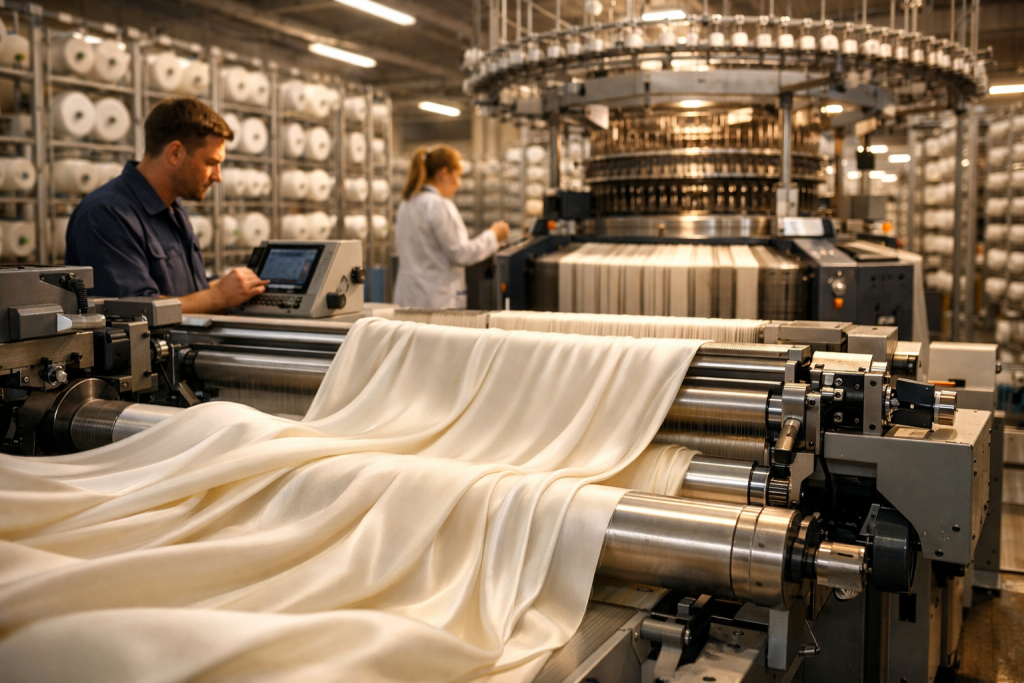
Working with viscose requires specific knowledge and adjustments compared to cotton or synthetics. Its unique properties—beautiful drape, silk-like feel, but lower wet strength and higher moisture sensitivity—demand optimized processing parameters.
At Reaghan Fashions, we work daily with manufacturers facing viscose processing challenges. This guide shares proven efficiency tips to maximize productivity while maintaining quality.
Understanding Viscose’s Unique Processing Characteristics
Before optimization, understand what makes viscose different:
Key Properties Affecting Processing:
- 40-50% strength loss when wet (critical during sizing, dyeing)
- High moisture regain (11-13%) (affects weight, handling)
- Excellent drape (requires gentle handling)
- Lower abrasion resistance (machine settings need adjustment)
- Prone to pilling (especially spun yarn)
- Excellent dye absorption (advantage for vibrant colors)
Processing Principle: Treat viscose gently, control moisture, reduce tension
PART 1: Weaving Optimization
1. Yarn Preparation for Weaving
Warp Sizing: Critical for Success
Viscose’s wet weakness makes sizing essential. Proper sizing reduces warp breakage by 60-80%.
Optimized Size Recipe for Viscose:
- Modified starch: 65-70% (better film formation than native starch)
- PVA (Polyvinyl alcohol): 10-15% (adds strength and flexibility)
- Wax/softener: 8-12% (reduces friction)
- Lubricant: 5-8% (smooth shedding)
Size Add-on Target: 10-12% by weight
Application Parameters:
- Temperature: 85-95°C (ensure complete starch gelatinization)
- Squeeze pressure: Moderate (avoid over-compression)
- Drying: Gradual (prevent case hardening)
- Moisture after sizing: 6-8%
Efficiency Tip: Pre-mixed size solutions save 20-30 minutes per batch
Quality Check: Regularly test size pick-up percentage; ±1% variation acceptable
2. Loom Settings for Viscose
Tension Management:
- Warp tension: 15-20% lower than cotton
- Reason: Prevent yarn breakage due to lower strength
- Adjustment: Use tension meters for consistency
Speed Optimization:
- Recommended: 10-15% slower than cotton equivalent
- Example: If cotton runs at 400 PPM, run viscose at 340-360 PPM
- Benefit: 40-60% reduction in warp breaks justifies slight speed reduction
Shed Timing:
- Early opening: Reduces abrasion
- Smooth shed formation: Prevents jerking
- Check: Regular shed geometry verification
Pick Spacing:
- Consistent beat-up: Prevents barre effects
- Regular monitoring: Check fabric appearance every 30 minutes
3. Environmental Control
Critical for Viscose Weaving:
Humidity: 65-70% RH
- Below 60%: Yarn becomes brittle, increases breakage by 300%
- Above 75%: Excessive moisture, sizing softens
Temperature: 24-27°C
- Stable temperature prevents moisture fluctuation
Investment: Humidification system pays for itself in 6-12 months through reduced breakage
Efficiency Gain: Proper humidity reduces warp breaks by 50-70%
4. Preventive Maintenance
Weekly Checks:
✅ Reed condition (bent dents cause yarn breakage)
✅ Heald eye smoothness (rough edges damage yarn)
✅ Temple pins (worn pins cause selvedge issues)
✅ Picking mechanism (consistent weft insertion)
Monthly:
✅ Complete loom cleaning
✅ Lubrication as per schedule
✅ Tension system calibration
ROI: Planned maintenance reduces unplanned downtime by 60-80%
5. Defect Reduction Strategies
Common Weaving Defects & Solutions:
| Defect | Quick Fix |
|---|---|
| Warp breaks | Reduce tension 10%, increase humidity to 68-70% |
| Reed marks | Replace damaged reed immediately |
| Barre (bands) | Check yarn evenness, verify consistent tension |
| Selvedge damage | Adjust temple position, reduce tension |
| Tight/loose fabric | Verify pick spacing, check beat-up force |
Efficiency Metric: Target <5 warp breaks per 100,000 picks
6. Productivity Benchmarks
Expected Production Rates (per loom/day):
| Fabric Type | GSM | Production (meters) |
|---|---|---|
| Lightweight (Lining, Saree) | 60-90 | 70-95 |
| Medium (Shirting) | 100-130 | 50-70 |
| Heavy (Upholstery) | 150+ | 35-50 |
Efficiency Improvement Target: 15-20% increase within 3 months of optimization
PART 2: Knitting Optimization
1. Machine Selection & Settings
Gauge Selection:
- Viscose recommendation: 24-32 gauge (finer than cotton)
- Reason: Finer needles handle viscose’s lower strength better
Speed Settings:
- Circular knitting: 20-30 RPM (vs. 25-35 for cotton)
- Flat knitting: 0.8-1.2 m/s
- Benefit: Lower speed reduces yarn breakage by 50%
Tension Control:
- Positive feed systems: Highly recommended for viscose
- Consistent delivery: Prevents thick/thin places
- Investment ROI: 8-14 months through reduced defects
2. Yarn Preparation
Waxing:
- Light paraffin application: Reduces friction
- Amount: 0.3-0.5% by weight
- Result: 30-40% fewer needle breaks
Package Quality:
- Firm winding: Prevents slough-off during knitting
- Clean flanges: Avoids contamination
- Proper storage: Maintain 65% RH
3. Needle Management
Critical for Viscose:
Inspection Frequency: Every 8 hours of operation
- Check for bent, damaged, or worn needles
- Viscose is abrasive; needle life 20-30% shorter than cotton
Replacement Strategy:
- Replace needles at first sign of wear
- Don’t wait for fabric defects
- Cost of needle << Cost of defective fabric
Needle Selection:
- Rounded latch: Prevents yarn damage
- Polished surface: Reduces friction
- Quality brands: Initial cost higher but longer life
Efficiency Impact: Proper needle management reduces holes/defects by 60-80%
4. Environmental Control
Humidity: 70-75% RH (slightly higher than weaving)
- Prevents static electricity
- Reduces yarn breakage
- Improves loop formation
Temperature: 23-26°C
Investment: ₹3-8 lakhs for mid-size unit; ROI in 10-18 months
5. Common Knitting Issues & Solutions
| Problem | Cause | Solution |
|---|---|---|
| Holes | Yarn breaks, damaged needles | Reduce speed 10%, inspect needles daily |
| Horizontal lines | Tension variation | Install positive feed, check yarn quality |
| Spirality | Unbalanced construction | Adjust stitch cam, proper finishing |
| Barre effect | Yarn irregularity | Source better quality yarn (U% <12%) |
| Oil stains | Excess lubrication | Reduce oiling, clean regularly |
6. Productivity Benchmarks
Production Rate (kg/machine/day):
| Fabric Type | Gauge | Expected Output |
|---|---|---|
| Single Jersey | 24-28 | 25-40 kg |
| Rib/Interlock | 24-32 | 20-30 kg |
| Jacquard | 28-32 | 15-25 kg |
Optimization Target: 20-25% productivity increase over 6 months
PART 3: Dyeing & Finishing Optimization
1. Pre-Treatment Efficiency
Scouring:
- Temperature: 70-80°C (lower than cotton saves energy)
- Time: 40-50 minutes (viscose cleans easily)
- Chemicals:
- Detergent: 2 g/L (vs. 3-4 g/L for cotton)
- Soda ash: 3 g/L
Energy Saving: 15-20% compared to cotton processing
Efficiency Tip: Continuous scouring ranges process 200-400 meters/hour vs. 50-80 in batch
2. Dyeing Optimization
Dye Class Selection:
For Cost Efficiency:
- Direct dyes: Simplest application, lowest cost
- Process: 60-80°C, 45-60 minutes
- Salt requirement: 20-60 g/L depending on depth
For Quality/Fastness:
- Reactive dyes: Better wash fastness
- Process: 60-80°C, 60-90 minutes
- Fixation: Alkali addition (soda ash/caustic)
Liquor Ratio Optimization:
- Standard: 1:10 to 1:12
- Low liquor machines: 1:6 to 1:8
- Water saving: 30-40%
- Energy saving: 25-35% (less water to heat)
Recipe Standardization:
- Create library: Document proven recipes
- Right-first-time rate: Increase from 75-85% to 92-97%
- Re-dyeing reduction: Save 8-12% of production time
3. Finishing Efficiency
Sanforizing (Compressive Shrinkage):
- Essential for viscose: Prevents garment shrinkage
- Process speed: 15-25 m/min
- Residual shrinkage: <2-3%
Calendering:
- Temperature: 120-140°C
- Pressure: Moderate (high pressure can damage cellulose)
- Speed: 25-40 m/min
- Result: Smooth finish, enhanced luster
Stentering:
- Temperature: 110-130°C (lower than polyester saves energy)
- Over-feed: 2-4% (compensates for shrinkage)
- Width setting: Buyer requirement + 1-2 cm allowance
Chemical Application (Softening, etc.):
- Pad-dry-cure method: Most efficient
- Squeeze pressure: 70-80% wet pickup
- Curing: 140-150°C for 60-90 seconds
Efficiency Gain: Continuous finishing processes 300-500 m/hour vs. 100-150 in batch
4. Water & Energy Conservation
Water Recycling:
- Final rinse water: Reuse for initial wash (30% water savings)
- Filtration systems: Remove particulates for reuse
- ROI: 12-24 months depending on scale
Energy Optimization:
- Heat recovery: Capture steam from drying cylinders
- Insulation: Reduce heat loss in dyeing vessels
- Energy savings: 20-30%
Digital Monitoring:
- Real-time tracking: Water, energy, chemical consumption
- Data-driven decisions: Identify waste points
- Investment: ₹5-15 lakhs; payback in 18-30 months
PART 4: Garment Manufacturing Optimization
1. Cutting Efficiency
Marker Planning:
- Computerized marker making: Optimize fabric utilization
- Viscose drape consideration: Account for fabric relaxation
- Target efficiency: 85-92% (vs. 82-88% manual)
- Waste reduction: 3-5%
Fabric Relaxation:
- Critical for viscose: Allow 12-24 hours relaxation post-finishing
- Prevents: Dimensional issues after cutting
- Storage: Lay flat or loose rolls in controlled environment
Spreading:
- Gentle handling: Prevent stretching
- Ply count: Lower than synthetics (viscose weight)
- Alignment: Check every 10-15 plies
2. Sewing Optimization
Needle Selection:
- Type: Ballpoint or universal (sharp can damage fibers)
- Size: 70/10 to 90/14 depending on fabric weight
- Quality: Premium needles reduce skipped stitches by 40%
Thread Selection:
- Core-spun polyester: Best strength and elasticity
- Size: 50-60 for lightweight, 40 for medium-heavy
- Avoid: 100% cotton (lower strength causes seam failure)
Machine Settings:
| Parameter | Lightweight | Medium | Heavy |
|---|---|---|---|
| Stitch/inch | 12-14 | 10-12 | 8-10 |
| Tension | Medium-low | Medium | Medium |
| Presser foot pressure | Light | Medium | Medium-firm |
Feed Dog: Ensure even feeding (prevent puckering)
3. Seam Quality
Common Issues & Solutions:
Puckering:
- Cause: Excessive tension, wrong stitch density
- Solution: Reduce tension 10-15%, use 11-12 SPI
Seam Slippage:
- Cause: Loose weave, insufficient seam strength
- Solution: Double-stitched seams, tighter fabric construction
Skipped Stitches:
- Cause: Wrong needle, timing issues
- Solution: Use ballpoint needles, service machine
Efficiency Gain: Proper settings reduce rework by 50-70%
4. Pressing & Finishing
Steam Pressing:
- Temperature: 140-160°C (medium setting)
- Steam: Moderate (viscose absorbs moisture)
- Pressure: Light to medium
- Caution: Avoid shiny marks (over-pressing)
Final Inspection:
- 100% check: Worth the investment for quality
- Defect classification: Critical, major, minor
- Rework vs. rejection: Cost-benefit analysis
PART 5: Waste Reduction & Cost Control
Waste Minimization Strategies
1. Yarn Waste:
- Cone wastage: <0.5% (use cone winding machines)
- Warp preparation waste: 1.5-2% (optimize warping)
- Selvedge waste: Account in costing (2-3%)
2. Fabric Waste:
- Cutting room: 8-15% depending on style
- Optimization: Computerized markers save 3-5%
- Waste utilization: Sell for recycling or craft use
3. Defect Reduction:
- Target: <2% second-quality fabric
- Method: Process control, quality checks
- Impact: Direct profit improvement
Overall Waste Target: <5% total material waste
Cost Control Measures
1. Energy Management:
- LED lighting: 60% electricity savings
- Variable frequency drives: Optimize motor speeds (20-30% savings)
- Scheduled operations: Run heavy equipment during off-peak tariff
2. Chemical Optimization:
- Precise dosing: Automated systems (reduce waste by 15-25%)
- Bulk procurement: 8-12% cost savings
- Supplier negotiation: Long-term contracts
3. Labor Productivity:
- Skill training: 15-25% efficiency improvement
- Incentive systems: Quality and quantity-based rewards
- Multi-skilling: Flexibility in workforce deployment
4. Inventory Management:
- Just-in-time: Reduce working capital by 30-40%
- ABC analysis: Focus on high-value items
- FIFO system: Prevent material aging
PART 6: Technology Integration
Automation ROI:
| Technology | Investment | Payback Period | Benefit |
|---|---|---|---|
| Auto cone winding | ₹8-15 lakhs | 18-30 months | 50% labor reduction, better quality |
| Positive feed knitting | ₹12-25 lakhs | 12-24 months | 30% defect reduction |
| Auto inspection | ₹20-40 lakhs | 24-36 months | Consistent quality, labor savings |
| Digital printing | ₹40-80 lakhs | 30-48 months | Short-run efficiency, design flexibility |
Start Small: Pilot in one production line before full implementation
Key Performance Indicators (KPIs)
Track These Metrics:
Production Efficiency:
- Machine utilization: Target >85%
- Production/machine/day: Benchmark and improve 15-20% annually
- First-time-right rate: >95%
Quality:
- Defect rate: <2%
- Customer rejection: <0.5%
- Rework percentage: <3%
Cost:
- Material waste: <5%
- Energy consumption: Reduce 10-15% year-on-year
- Labor productivity: Meters per operator per day
Reaghan Fashions: Your Efficiency Partner
How We Support Your Production Optimization:
✅ Right Yarn for Your Process:
- Filament vs. spun guidance
- Count/denier selection for efficiency
- Consistent quality (reduces process variation)
✅ Technical Consultation:
- Processing parameter recommendations
- Troubleshooting support
- Best practices sharing
✅ Quality Consistency:
- Batch-to-batch uniformity
- Reduces machine setting changes
- Predictable processing behavior
✅ Flexible Supply:
- Just-in-time delivery
- Inventory optimization support
- Multiple packaging options
✅ Cost Optimization:
- Competitive pricing
- Volume discounts
- Value engineering suggestions
Action Plan: 90-Day Optimization Roadmap
Month 1: Assessment & Quick Wins
- Audit current processes
- Implement humidity control
- Optimize machine settings
- Train operators on viscose specifics
Month 2: Process Standardization
- Document best practices
- Create SOPs
- Implement quality checkpoints
- Baseline KPI measurement
Month 3: Continuous Improvement
- Analyze data
- Identify bottlenecks
- Pilot automation/technology
- Set improvement targets
Expected Results: 15-25% efficiency improvement, 30-50% defect reduction
Conclusion
Optimizing viscose production requires understanding its unique characteristics and adjusting every process step accordingly. The investment in optimization—whether equipment, training, or environment control—delivers substantial ROI through reduced waste, higher productivity, and better quality.
Remember: Small improvements across multiple areas compound into significant competitive advantage.
Partner with Reaghan Fashions for quality viscose yarn and expert guidance to maximize your production efficiency.
Contact Reaghan Fashions today for:
📞 Technical consultation on processing optimization
🧵 Consistent quality viscose yarn
📊 Processing parameter guidance
💡 Custom solutions for your production needs
